



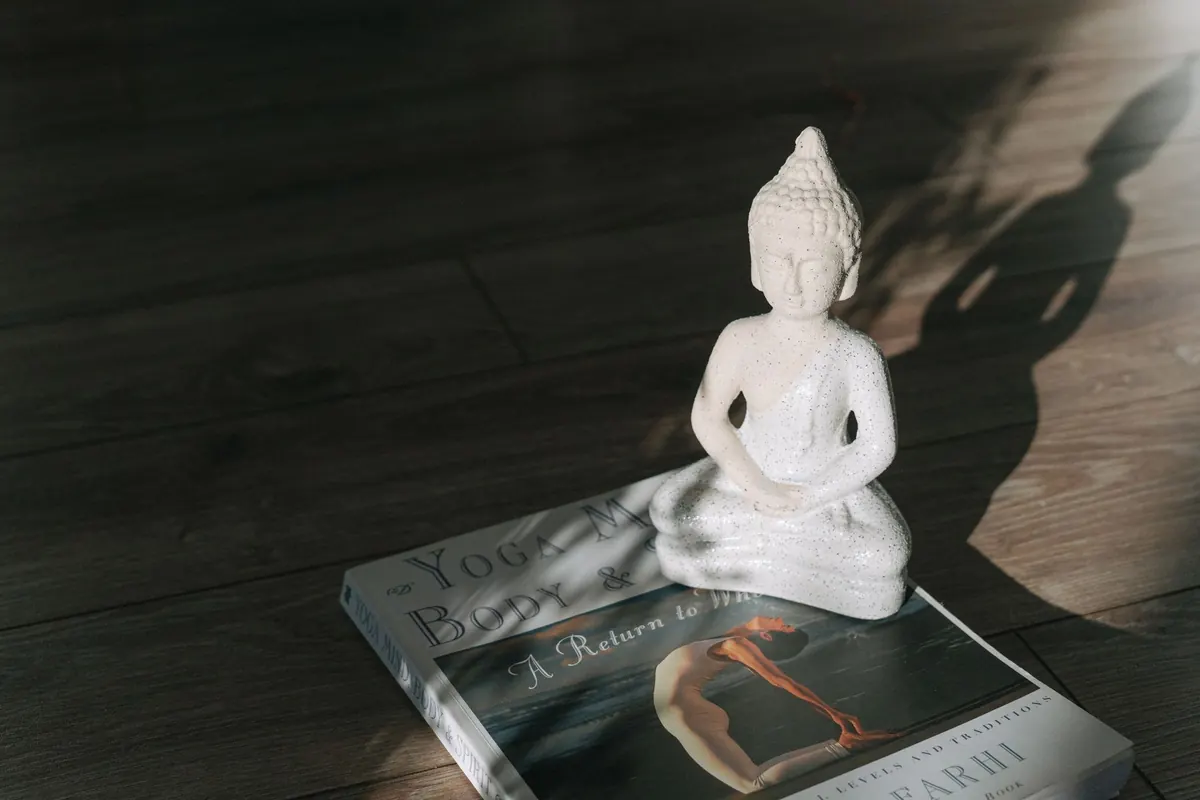


You sit down, close your eyes, and within half a minute your mind is drafting an email, replaying a conversation from Tuesday and wondering whether you locked the back door. Nothing has gone wrong. That scattering of attention is not proof that you cannot meditate; it is the very material meditation works with. Even so, a few habits make the early weeks far harder than they need to be — small misunderstandings that turn an ordinary practice into a test you seem to keep failing. Here are seven of the most common, each with a gentler way forward.
1. Gripping your attention instead of guiding it
The most frequent mistake is trying to force focus. You choose the breath, then clamp down on it: jaw tight, shoulders up, silently ordering yourself to concentrate. A minute later you are exhausted and quietly convinced you have no aptitude for this at all.
Attention is not held in place by pressure. It is steadied the way a child learns to walk — by falling, noticing, and starting again, many times, without drama. Each return to the breath is the repetition that builds the capacity. The wandering is not the failure; the wandering is the practice.
If narrow focus feels like a fight, widen it instead. Feel the breath and the weight of your body on the chair, and let sounds arrive and leave. Open awareness is often easier to settle into than a single point, and it trains the same muscle.
2. Treating thoughts as the enemy
Many beginners assume the goal is to stop thinking, so every thought feels like a trespasser to be shoved out of the room. That creates a quiet war inside your own head, and wars are not restful.
Thoughts are not obstacles to mindfulness. The moment you notice you have been lost in one is the moment you have woken up — that noticing is the exercise. So rather than pushing a thought away, label it lightly: thinking, planning, worrying. Let it pass, then return to your anchor. You are not clearing the sky; you are learning to watch the weather.
3. Judging yourself for wandering — and for judging
Then comes the commentary: I'm useless at this. Everyone else can sit still. I've wasted ten minutes. Notice the tone. If you would not say it to a friend learning something new, it does not belong in your practice either.
There is a second layer, too. You notice you are judging, and then you judge yourself for judging. When that happens, treat it exactly like any other thought: note judging, soften, return. A sentence that helps is simply, "Wandering. That's fine. Back to the breath." No lecture, no penalty, no post-mortem.
4. Chasing a particular feeling
If you meditate in order to feel calm, you have added a second job to the first one. Now you are breathing and checking whether it is working, which is a reliable way to feel neither calm nor present.
Some sessions are soft and spacious. Others are restless, dull or faintly irritating. Both are valid, and neither predicts much about the next one. Measure success by whether you showed up and noticed what was there, not by the mood you left with. On the difficult days, try naming the state: restless, tired, edgy. Naming it creates a little space around it, and that space is the point.
5. Sitting in a way your body resents
You do not need to fold your legs into a knot. You need a position you can hold without bracing. A firm chair, feet flat on the floor, hips slightly higher than your knees, spine upright but not stiff, hands resting on your thighs — that works beautifully, and it is not a lesser version of the real thing.
Choose eyes closed, or open with a soft downward gaze if closing them makes you drowsy. If discomfort appears, move deliberately: adjust your posture, shift your weight, swallow, then settle again. Stillness is a direction, not a rule. If you are managing an injury or persistent pain, walking meditation may suit you better — and for anything ongoing, speak to your GP or a physiotherapist.
6. Doing too much, too soon
Enthusiasm often arrives all at once: twenty minutes on Monday, thirty on Tuesday, and by Friday the cushion is gathering dust because the whole business has started to feel like homework. Five minutes every day will do far more for you than an ambitious hour once a week.
Start with five to ten minutes, five days a week. When that feels ordinary rather than heroic, add a few minutes. Short, frequent sessions build the habit; long, sporadic ones mostly build resistance.
7. Turning it into another thing to get right
Streaks, apps, the perfect cushion, the correct technique — these can quietly convert a practice into a performance. Then a missed morning feels like failure, and you skip the next one because the run is broken.
Remember what you are actually doing: noticing what is happening, without adding a story on top. If you miss three days, sit down for two minutes and begin again. Nothing has been ruined, and no one is keeping score. A practice that survives imperfect weeks is worth more than one that only works in ideal ones.
A short practice you can keep
If you want something simple to hold on to, try this:
- Pick a regular time and place — after your morning coffee, on the same chair.
- Set a timer for five or ten minutes.
- Sit comfortably, take three slower, fuller breaths, then let the breath find its own rhythm.
- Rest your attention lightly on the feeling of breathing. When it wanders, note where it went and come back. Repeat as often as needed — that repetition is the whole exercise.
- When the timer sounds, pause for a moment before getting up. Notice how you feel, without deciding whether it was a good session.
Aim for consistency rather than intensity: five days a week is plenty. Two minutes in a parked car counts. Ten distracted minutes count. What does not help is waiting until you can do it perfectly, because that day tends not to arrive.
One last note. If meditation brings up distressing memories, or intensifies anxiety or low mood, step back and speak to a qualified mindfulness teacher, a therapist or your GP. That is sensible care, not a failure of practice — and support is there if you want it.
Photo: Pezibear / Pixabay